Modernism was supposed to be against ornament. Then it moved to the desert and met the sun.
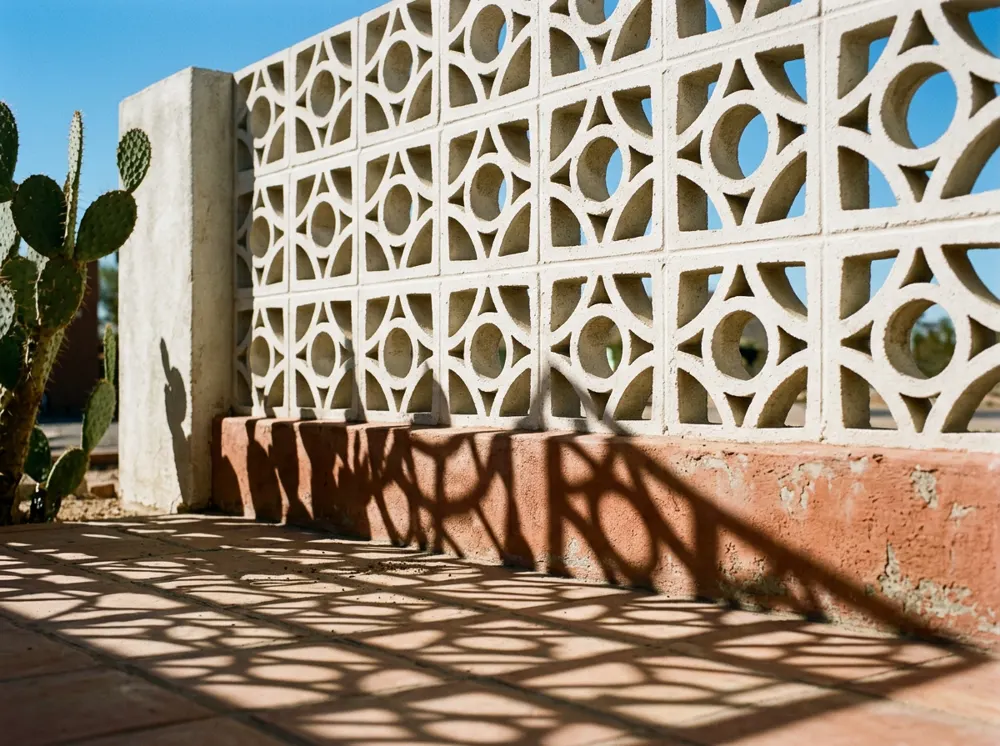
The breeze block — a hollow concrete masonry unit cast in a decorative, perforated pattern — solves a very specific problem. You want privacy and shade, but you also want air to move and light to filter through. A solid wall traps heat. Glass bakes. A screen of breeze blocks does both jobs and throws a living pattern of shadow across the ground that shifts every hour of the day.
A pattern for every porch
The block traveled fast in the 1950s and '60s. Architect Edward Durell Stone made decorative screens central to his work, and manufacturers turned out dozens of off-the-shelf designs: circles, crosses, diamonds, flowers, interlocking waves. Developers loved them because they were cheap, quick to stack, and made a plain tract house look custom.
A solid wall traps heat. Glass bakes. A screen does both jobs.
In Palm Springs they show up everywhere: hiding carports, fencing pools, wrapping motel stairwells, lining the entrance to a bank. They are the town's punctuation.
Reading the shadows
Here's the thing photographs rarely capture: a breeze block wall is a clock. At 9 a.m. the shadows are long and soft-edged. At noon they shrink into tight, hard geometry right at the base. By 5 p.m. they stretch back out across the floor in the opposite direction — warmer now, and somehow more forgiving.
Spend a morning sitting next to one. It's the cheapest architectural tour in the valley.
The revival
After falling out of fashion in the 1970s, breeze blocks are back — reissued in original patterns, specified for new builds, painted in flamingo pink for boutique hotels. Purists grumble. But the block was always about pleasure as much as performance, and it's hard to argue with a wall that turns sunlight into lace.