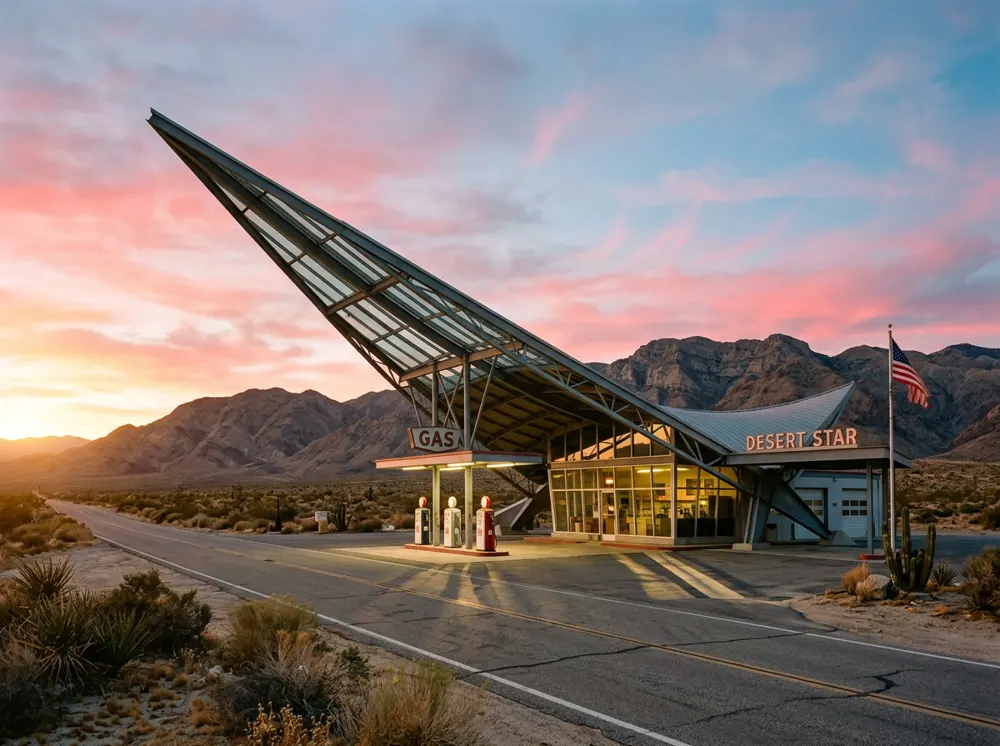
Coming into Palm Springs from the north, you hit it before you hit anything else: a sharp, dramatic roof that seems to be peeling off the ground and launching toward the mountains. It is, improbably, a gas station.
Built in 1965 at the foot of the road to the Palm Springs Aerial Tramway, the station was designed by Albert Frey and Robson Chambers to catch travelers on their way up the mountain. The roof is a hyperbolic paraboloid — a saddle-shaped surface that curves up on two corners and down on the other two — and it cantilevers out over where the pumps once stood, ready for a crowd of tailfins.
Geometry as signage
In the jet age, a roadside building had a few seconds to make an impression at 50 miles an hour. Frey and Chambers made the structure itself the sign. No neon required: the roof is the logo, the billboard and the shade all at once.
The roof is the logo, the billboard and the shade all at once.
The geometry is also rigorous. A hyperbolic paraboloid can be built from straight members even though it reads as a curve, which made it efficient as well as spectacular. It's the kind of trick Frey loved: maximum effect, minimum fuss.
Second life
The pumps are long gone. After years of uncertain use, the building was restored and opened as the Palm Springs Visitors Center, and it has become the unofficial front door to the city's modernist legacy. Inside you'll find maps, architecture tour information, and the kind of people who can tell you which Alexander house has its original front door.
Make it the first stop
Arrive in the late afternoon, park across the road, and wait for the sun to drop behind the San Jacintos. The underside of the roof goes gold, then blue. Then go in and plan the rest of your trip.