In 1937, Frank Lloyd Wright — seventy years old and freshly famous all over again for Fallingwater — went looking for a place to spend the winters. He found it on the lower slopes of the McDowell Mountains, northeast of Phoenix, on a stretch of Sonoran desert that most people would have considered useless.
He and his apprentices from the Taliesin Fellowship built a camp there by hand. They called it Taliesin West, and they kept building it, revising it, and rebuilding it for the rest of Wright's life.
Made of the ground
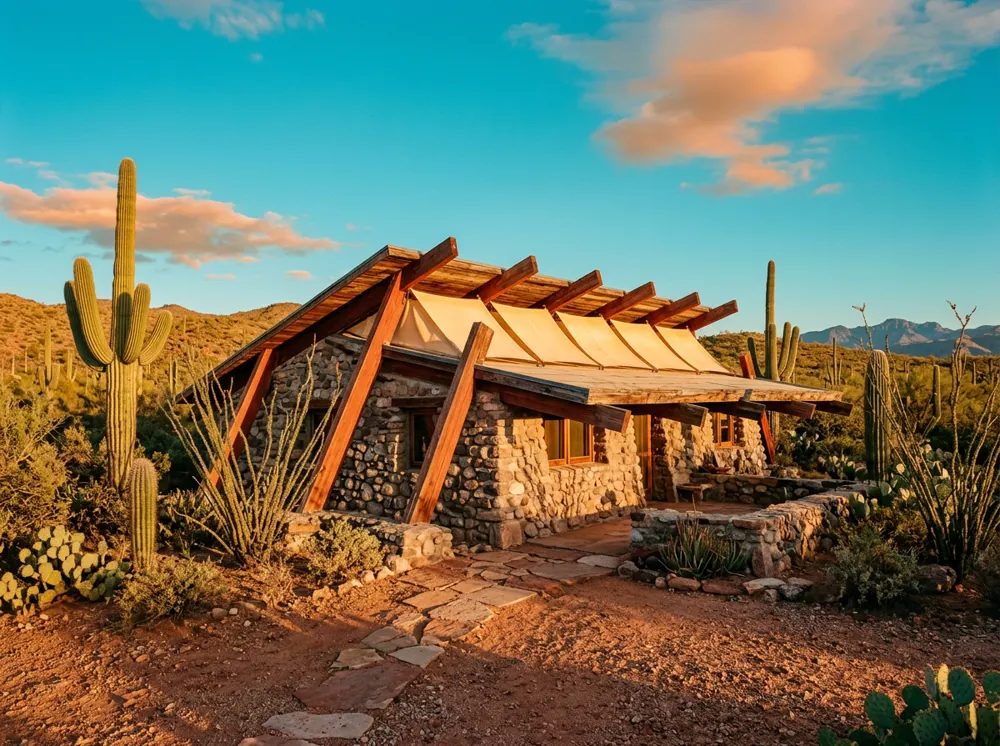
Wright's solution for building in the desert was what he called "desert masonry": local stones, gathered from the site, packed into wooden forms and bound with concrete. The flat faces of the rocks were turned outward. When the forms came off, the walls looked as though they had been pushed up out of the earth — rust, ochre, violet, gray.
The walls look as though they had been pushed up out of the earth.
Above the heavy stone bases, Wright set angled redwood trusses and, originally, roofs of white canvas. The canvas filtered the brutal sun into a soft, diffused glow and could be rolled back on cool nights. Later, for durability, much of it was replaced — but the effect, that strange combination of fortress and tent, survives.
A school, still
Taliesin West was never just a house. It was a studio, a school and a laboratory where Wright's apprentices learned by doing. Today it's a National Historic Landmark and, since 2019, part of a UNESCO World Heritage listing for Wright's twentieth-century architecture.
Visiting
Book a guided tour — that's the only way in, and the guides are excellent. Go in the morning in cooler months, when the light comes in low across the triangular terraces and the stone walls hold the night's chill. Then stand on the prow of the main terrace and look south across the valley, and try to imagine it all before the city arrived.