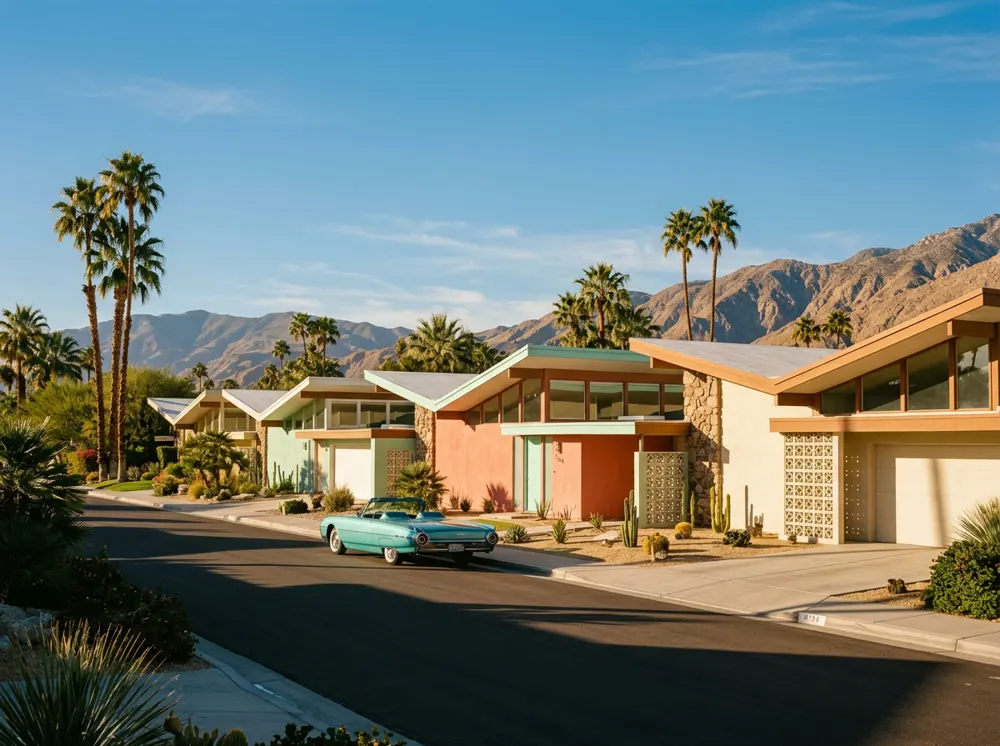
Take an ordinary gable roof. Now flip it upside down. That's the butterfly: two roof planes that rise toward the edges and dip in the middle, like wings caught mid-beat.
It's a small move with outsized consequences. The low point in the center becomes a gutter. The high edges open up for clerestory windows, pulling north light deep into the house. And from the street, the whole building suddenly reads as lift — optimistic, jaunty, a little bit space-age. Which is exactly what postwar America wanted to buy.
The developers who made it a neighborhood
In the mid-1950s, the father-and-son builders George and Robert Alexander set out to bring modernism to the middle class. Working with the architects Dan Palmer and William Krisel, they produced more than two thousand homes in Palm Springs — affordable, efficient, and cleverly varied.
A small move with outsized consequences: the whole building suddenly reads as lift.
Krisel's trick was variety from a kit of parts. The floor plans were nearly identical, but each house could be rotated on its lot, given a different roofline — flat, gabled, or butterfly — and painted in a different colorway. Walk a block in the Twin Palms neighborhood and no two houses match, yet every one is unmistakably related.
How to spot one
- Look up at the fascia. A true butterfly has a visible V in profile, with the deepest point roughly over the center of the house.
- Find the clerestories. Thin bands of glass tucked under the high edges are a giveaway.
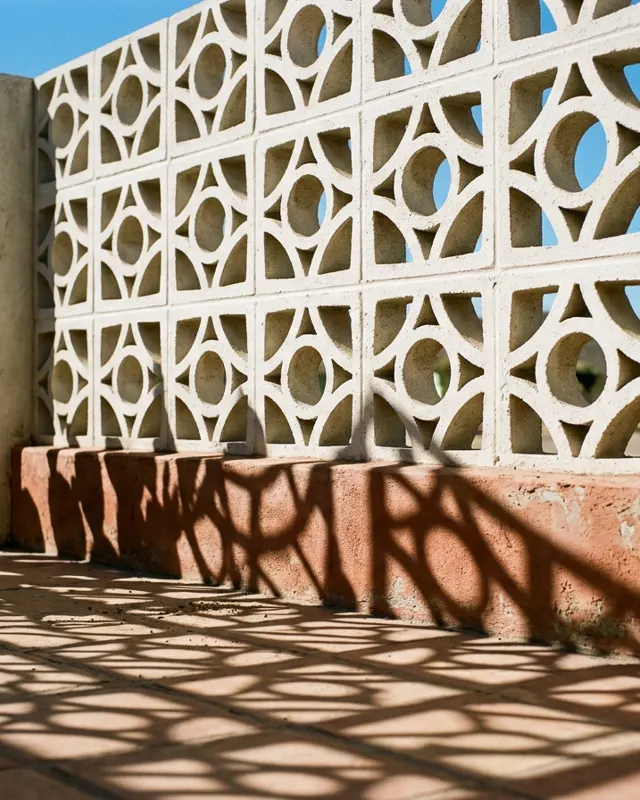
- Check the carport. Many Alexanders pair the butterfly with a cantilevered carport roof and a decorative block screen.
- Note the color. Original palettes ran to sea-foam, coral, and butter yellow — often with a bright front door.
Where to walk
Start in Twin Palms, the Alexanders' first big tract, then head to Vista Las Palmas, where the lots get bigger and the rooflines more theatrical. Go in the morning, before the heat, and bring a camera with a wide lens. The roofs are low; the sky is not.