You don't arrive in Marfa by accident. It's three hours from the nearest major airport, on a high, windy grassland where the Chihuahuan Desert meets the Davis Mountains. The town has a population of under two thousand people, a few blinking traffic lights, and one of the most important art installations in the world.
Donald Judd came here in the early 1970s, fed up with how museums treated art — hung briefly, packed away, never seen in the right space or the right light. He wanted the opposite: works installed permanently, in buildings tuned to them, in a landscape big enough to breathe.
The artillery sheds
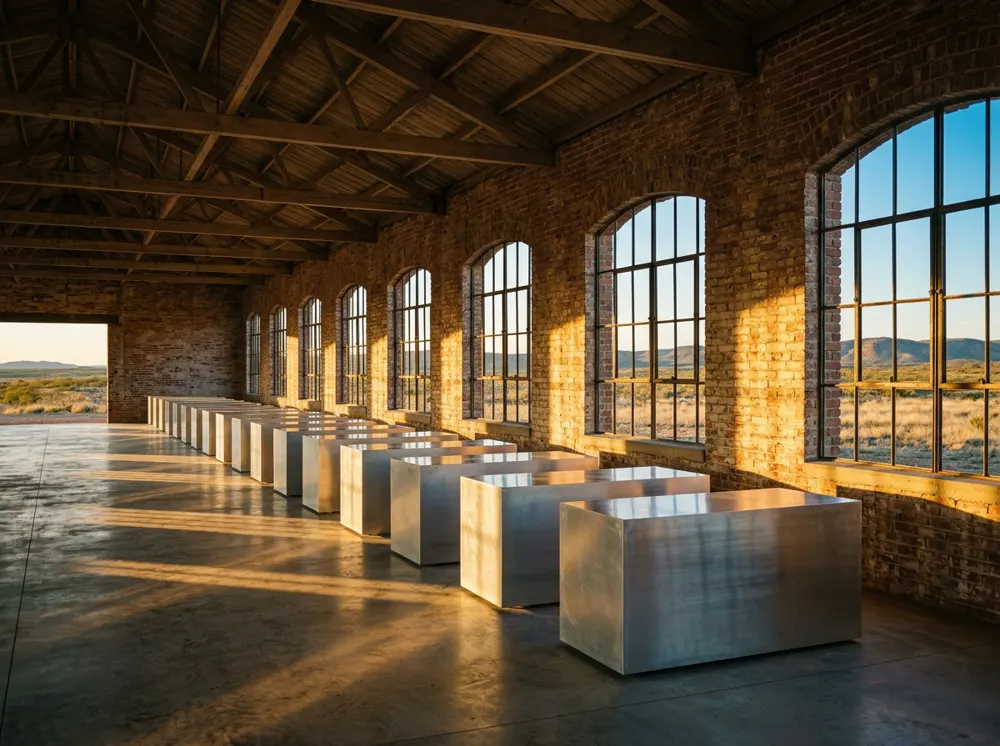
With the support of the Dia Art Foundation and, later, through his own Chinati Foundation, Judd acquired the former Fort D.A. Russell on the edge of town. Inside two long brick artillery sheds, he installed 100 untitled works in mill aluminum — a hundred boxes, each with the same outer dimensions, each opened, divided or slotted differently inside.
The building is the instrument. The sun plays it.
He replaced the sheds' garage doors with continuous walls of glass and added a vaulted roof of corrugated metal. The result is a building that functions like an instrument: as the sun crosses the sky, the boxes go silver, gold, gray, and almost invisible, reflecting the grass and the sky and each other.
Architecture as patience
It's tempting to call Marfa minimalist and leave it there. But the real lesson is about time. Judd built for permanence in a culture of churn. You can't see the work in an hour. You have to come back — morning, afternoon, a cloudy day — and let the light do the talking.
Making the trip
Book Chinati ahead and give it a full day. Stay a night or two in town; eat late. And on the drive out, pull over at dusk somewhere on Highway 90 and watch the sky go wide and pink over the grassland. That's part of the installation, too.