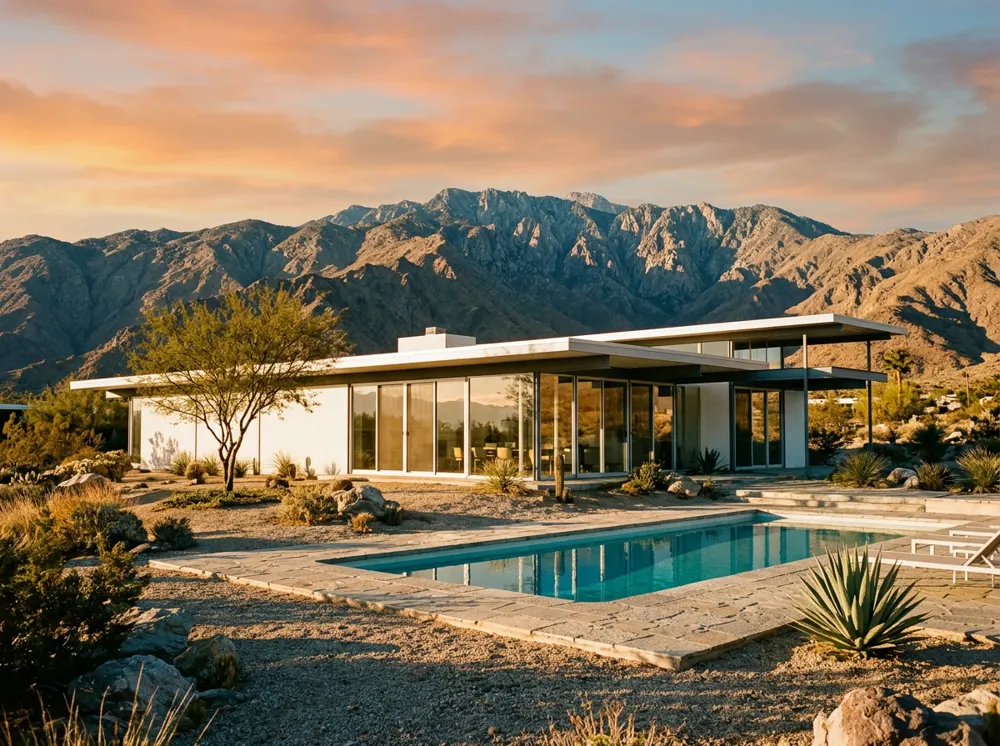
The first thing you notice is that there is almost nothing to notice. A low white line on a gravel plain. A few aluminum blades catching the light. Then the mountain behind it moves into focus and you understand: the house is not the object here. The house is the frame.
Edgar J. Kaufmann — the Pittsburgh department-store magnate who had already commissioned Frank Lloyd Wright's Fallingwater — wanted somewhere to spend his winters. He went to Richard Neutra, the Vienna-born architect then busy rewriting what a Southern California house could be, and asked for something light. What he got, in 1946, was a building that seems to hover a few inches above the sand.
A pinwheel in the sand
Neutra laid the plan out like a pinwheel: four wings spinning off a central living space, each one reaching toward a different view and a different microclimate. One arm points at the pool. One shelters guest quarters. One reaches for the mountain. Between them, the desert slides right up to the glass.
The house is not the object here. The house is the frame.
The walls that aren't glass are stacked desert stone, rough and honey-colored, as if the ground had been persuaded to stand up for a moment. Overhead, the flat roof cantilevers far past the windows, cutting the noon sun down to a stripe.
The room on the roof
Up top sits the detail everyone remembers: the gloriette, an open-air rooftop room screened by vertical aluminum louvers that can be pivoted against the wind and the glare. It is a lookout, a sleeping porch, a sundial. At dusk, the louvers go copper, then violet, then black.
In 1947 the photographer Julius Shulman shot the house at twilight, with Liliane Kaufmann stretched out by the pool and the lights blazing inside. The image — later known as Poolside Gossip — did more to sell the idea of desert modernism than any manifesto. Look at it long enough and you can hear the ice in the glasses.
How to see it
The house remains a private home, and the owners have earned their privacy. But the street view is generous: from West Vista Chino you can read the long roof plane and the stone walls against the mountain. Go at the last hour of light, when the San Jacintos go pink and the glass turns into mirror — that is the house Neutra drew.